Monday, February 27, 2012

Fabruary 27th part 1 - Paro (Hike to TIgers Nest)

Last night Erica stopped by our room to let us know that we would be meeting with the Queen Mother (Queen Ashi Tshering Yangdon, former Queen of Bhutan and mother of the current King) today at the royal compound in Thimpu. Erica had gotten to know the royal family of Bhutan when the youngest daughter was at Stanford. Since we were already planning on hiking to Tigers Nest in the morning, this was going to be a very packed day.

At 8:30 Chris, Jon, Madeleine, Arial, Sammy and myself set off for the grueling hike to Tigers Nest Monastery (real name Taktsang Palphug Monastery) - site of an old buddhist monastery build 3000 feet up on the side of a cliff. The monastery unfortunately burnt down during the 1980's but was faithfully restored to its former self.

This is one of the most sacred places in Bhutan, and legend has it that the Guru Rimpoche flew there on the back of a Tigress (who some say was also his wife taking on one of her many forms).

I knew this was going to be a hard hike due to the altitude and the little time we had had for aclimitization. As it was, I had a hard time making it up the one flight of stairs to our room at the hotel. The hike starts at 7000 feet and ascends to 10,000 feet.


From the parking lot we passed the usual stalls selling souveniers, water, walking sticks etc. and then passed some buildings which appears to be shrines - presumably part of the original monastery complex built in the 1600's. Prayer flags were everywhere along the entire hike.Very soon we came to an open area where one could see our destination way off in the distance and very high up!


Due to the fact that no roads connect the monastery, all items must be carried by hand or on the backs of pack animals. We saw numerous horses and mules carrying supplies and also saw people carrying huge pieces of furniture on their backs running down the trail.

After an hour of grueling swtichbacks we reached what appeared to be a restaurant. By this time I had fallen behind, and was happy to see Sammy and our guide Gung Chow had waited for me. An ice cold Fanta provided a welcome refreshment while contemplating the next and hardest part of the climb. Although the monastery was now a lot closer, reaching it required hiking to a lookout tower high above the monastery, and then descending several hundered narrow steps carved into the side of the rock. Although railings have now been added, it used to be the case that there was nothing between you and the valley floor 3000 feet below, and several hikers would end up getting killed each year.


The next bit was very tough due to the altitude, and I ended up having to stop to catch my breath every minute or so. The younger ones seemed to have much more stamina. It was very pleasant, however, and we were rewarded with amazing views of the Paro valley, and the Tigers Nest monastery getting closer and closer. Eventually we reached the highest point of the trek where there was a large prayer wheel and the start of the steps leading down to the monastery.


At the bottom of the stairs there was a waterfall, and I was surprised to see a large snow bank. I had been in my T shirt for most of the hike, but once in the shade it became icy cold. There were then a few steps up to the monastery. At this point we met some police officers who demanded to see our pass. Since we had separated from our guide, we did not have (or even know about) a pass. Faced with the possibility of having hiked this far and now being allowed into the monastery, Sammy started to get sad. Eventually, however, our guide showed up and we were able to tour the building. Cameras were not allowed in this sacred place, so I apologize for not being able to show any pictures.


All the waters surrounding the monastery are supposed to be sacred and have healing properties. Our guide went off to try and bottle some of the water for us, while we set off back down the trail on the much easier return part of the journey.


Panorama showing Taktsang Monastery and Paro Valley

We finally arrived back at the hotel at 1pm, covered in mud and sweat, having 20 minutes to prepare ourselves to meet the Royal family of Bhutan! (see part 2).

February 27th part 2 - Thimphu and Royal vist

First a little bit about the Royal family in Bhutan. The current King Jigme Khesar Namgyel was crowned in November 2008 at the age of 26 making him (at the time) the worlds youngest head of state. His father, King Jigme Singye Wangchuck abdicated the throne to his eldest son and (at the same time) announced parlimentary elections, smoothing the transition to democracy for this remote country.

The royal family is held in very high regard by the citizens of Bhutan. Pictures of the current king and his new bride, Jetsun Pema, appear everywhere, and above the doorway of every home.

The former King has four wives (all of whom are sisters), and a total of 10 children - five sons and five daughters. We met with Queen Ashi Tshering Yangdon Wangchuck, who is the mother of the current king. Also present were her two other children, Princess Ashi Dechen Yangzom, and Prince Dasho Jigme Dorji Wangchuck. We were also lucky enough to meet the newest member of the royal family, the little Princess daughter of Ashi Dechen Yangzom.


The former King and his 4 wives at the time of his marriage in 1979

Although it was special meeting the royal family, it was not at all unusual. A representative from the Royal family normally meets with all groups doing non profit work in Bhutan. This visit was significant, though, in that it came out of a special friendship that Dr Erica has with the Queen mother dating back to the time when her daughter attended Stanford.

After quickly showering and making ourselves presentable, we all piled into the bus for the hour long drive to Thimphu, the capital of Bhutan. The winding road follows downstream one fork of a river, and then upstream along the other fork through stunning canyons and valleys. The driver was quite rushed as it would not do to be late for the Queen! We arrived at the Royal compound with 5 minutes to spare, and were courteously ushered in by the palace guards.

For what had been scheduled as a 1 hour meeting, we ended up staying for 3 hours, and were absolutely captivated by the charm and graciousness of this amazing woman are her family. Even Sammy and Owen opened up, presenting pictures they had drawn of Buddha and a temple. We were served traditional Bhutanese food including momo's, deep fried waffles, and cake. I spent about an hour talking to the Princess about her time at Stanford, and about life in Bhutan. The little princess was captivated by Sammy, and spent the whole time following him around.

The Queen mother with her granddaughter


Sammy playing with the little Princess


Owen presenting a drawing to the Queen mother
Left to right. Jon Puro, Princess Ashi Dechen Yangzom and her daughter, Madeleine Traver, Dr Chris Traver, Arial, Dr Erica Weirich, Queen Ashi Tshering Yangdon Wangchuck, Cathy Leather, Owen Leather, Sammy Leather, me, Prince Dasho Jigme Dorji Wangchuck and his fiancee.

Around 7pm we checked into our new hotel in Thimphu and then headed downstairs for dinner. We were joined by Choki Lhamo, a good friend of Mike Hawley who was someone I worked with at Lucasfilm. She was involved with the project to create the worlds largest book - a 6 ft high collection of photos from Bhutan. We finally got to sleep around 10pm after the most exhilarating day of the trip.

Sunday, February 26, 2012

Febrary 26th - Kathmandu to Paro

We set of fairly early to the airport for our flight to Paro, Bhutan. At this point I was still nervous that there would be some problem with the visa's, but in the end Erica's contacts came through and we were allowed into the country with no problem. Getting through the airport at Kathmandu, however, was an exercise in chaos which would raise the blood pressure of even the calmest person. Upon leaving the van, numerous people rushed over wanting to "help" us with our bags in exchange for a tip. The ticketing hall was so full of people that one couldn't move. There were no obvious signs on where to go, and if you didn't have the right stamps or tags at any point, you were sent back to the beginning. Somehow we made it through all the lines with the right set of stickers and made it onto the plane along with the other passengers, half of whom were Buddhist monks.


Hanging out in the departures hall of Kathmandu airport

The short 60 minute flight took us into the beautiful Paro valley and one of the remotest spots on earth. The Himalayan Kingdom of Bhutan has been effectively cut off from the rest of the world until very recently. Even now, only a handful of tourists are allowed in each year.

The airport in Paro is considered one of the most difficult approaches in the world, and there are only 6 pilots certified to fly into this airport. The plane make a slow descent between two mountain ranges, and then makes a quick 90 degree turn at the last minute right before landing.


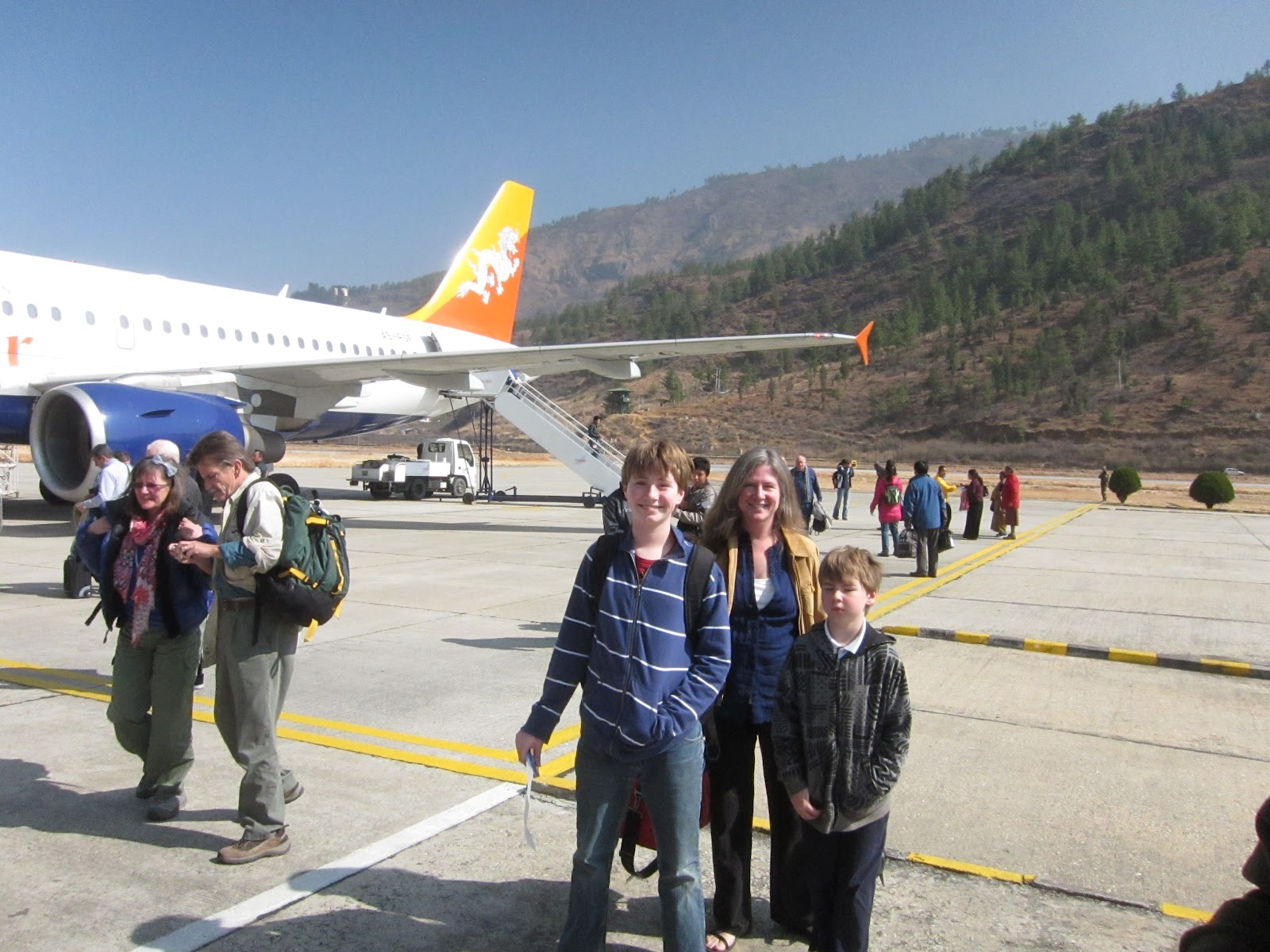
Sammy, Owen, and Cathy getting off the plane in Paro

Entry formalities took no time at all, and soon we met our guide, Gung Cho, and were on our way to the Hotel Zhiwa Ling. The short drive up the hill exposed us to the unusual architecture of Bhutan, and we were impressed by how clean and unchaotic everything was. The valley was just beautiful, although the usual snow covered peaks were not to be seen due to the effects of climate change. Soon we checked into the hotel, found our rooms, and then got back into the van for lunch at a local restaurant in the town of Paro.

The lobby of the Hotel Zhiwa Ling


A typical street scene in Paro

After lunch we went back to the Hotel, dropped off the kids, and then headed to a regional health facility higher up the mountain.  This health unit services the Taktshang complex (Tigers Nest temple) along with several remote villages along the border with Tibet, some of which are only reachable via a 4 day hike. Should we return to Bhutan late this year, I am hoping it might be possible to join a health worker as he/she visits some of these remote villages.

We had a relaxed dinner at the Hotel and were then promised no morning meetings the next day, allowing some of us to make the gruelling hike up to Tigers Nest.


Saturday, February 25, 2012

February 25th - Chitwan to Kathmandu

Today we split up the team. The kids and two of the adults took the plane back to Kathmandu, sparing them 5 hours of torchurous driving through narrow winding mountain roads. The rest of us went to Sauraha to visit with WWF and see the elephant dung paper making facility (don't laugh!)

There were no animal encounters on the way out of the park, and the road to Sauraha was surprisingly good. Sauraha is the tourist center of Chitwan and is packed full of Hotels, restaurants, and shops. There were elephants everywhere, and we passed a large race track where they hold elephant races twice a year. The meeting was at the main wildlife conservation center and was followed by a nice lunch which was prepared especially for us. Among other things we learned how rhino's are identified though a pattern of bulbous growths on the back side, every one of which is unique. The park rangers have given each of the 500+ rhino's in the park a name, which I though would make it sad when one of them dies. Poaching is a huge problem due to the high prices the rhino horn fetches on the Asian market. Seeing pictures of a rhino whose horn has been ripped out and the animal left to die is just heart wrenching.

Afterwards we visited the elephant dung factory. This is a sustainable facility set up by the green society of Nepal. The process is very similar to regular paper - the elephant dung is mixed with chemicals to form a slurry, and bleach is used to remove the brown color and the smell. A frame covered in a fine wire mesh is then dipped into the solution, and then left out into the sun to dry.


Our 5 hour trip back to Kathmandu ended up taking 7 hours due to a horrendous traffic jam over the pass caused by a stalled vehicle. The line did not move for literally an hour, and then once a policeman had arrived on the scene to control traffic, it started moving very slowly.


We finally arrived at the amazing Hotel Dwarikas at about 8pm just in time for dinner. Since Owen and Sammy had fallen asleep, we left a note saying where we would be, and went down to the restaurant where we were served a multi-course traditional Nepalese dinner which was by far the best meal we had had on the trip so far. Then a (relatively) early night since we needed to get up early the next day to catch our next flight.


Friday, February 24, 2012

February 24th. Chitwan NP

Today we made a side trip to the beautiful village of Laxmibas near Madi to see the health clinic there. This village is in the "buffer zone" surrounding the park, the the people there have a vested interest in maintaing the ecosystem and protecting the animals.

We set off around 8am in two vans - the kids were left behind to do another elephant safari and a hike to the surrounding lookout towers. The weather was very misty and it was hard to see any hazards ahead. Sure enough, after about 20 minutes we saw the faint shape of a huge rhino blocking the road. We waited a few minutes until the rhino slowly moved into the undergrowth, and then slowly proceeded. Upon passing the rhino we noticed that she had a baby with her. "This is not good!" said the ranger who was accompanying us. Suddenly we heard a huge snort and the mother rhino started to charge us. The driver immediately accelerated the vehicle but was having a hard time outrunning the rhino. Eventually, however, she got tired and slowed down.


This is the rhino which charged us

Once we left the park we headed west a through the many villages in the "Madi" area of Chitwan district. Although equally poor, these villages differed from the squalid roadside settlements we witnessed the day before. The villagers all looked happy and wore colorful dress. There were many school children walking or biking to school, all wearing clean blue uniforms. The houses were simple but clean, consisting of maybe a couple of rooms and an outhouse, a large stack of hay, and a couple of goats. This area subsists on farming, but there was no sight of any modern farming equipment - we saw maybe one tractor the whole journey. The electric grid has not reached this area yet (although there was a radio station), and the villages are completely cut off from the rest of Nepal during the 3 months of the monsoon season. As it was, we had to drive through many rivers to get there.


Once we got to the health clinic we saw that all the community leaders of the village had come out to meet us. It was very touching as they each presented us with a traditional silk sash and a flower lei. They seemed genuinely happy that westerners had made the long treck to come and see their village. We all introduced ourselves and at one point Dr Erica asked how many had cellphones, and literally everyone raised their hands.


Next we observed a few clinic visits with the doctor seeing mostly older patients. Despite the primitive conditions, she showed a connection with her patients that is not often seen in todays modern society. In all we spent about 3 hours at the village during which time we all fell in love with the people.

On the way back we stopped for a picnic lunch inside the park which seemed unadvisable given the events of the morning! We reached the resort at 3pm and met up with our children who had had a great day. Next it was time to get in an open topped truck for our afternoon safari and river boat ride.


After driving for half an hour through primitive back roads we reached the river. All 8 of us piled into one boat, and we set off down the crocodile infested river. We were reassured that the crocodiles fed mainly on fish, resorting to eating people only when there was no other food.


On the way back from the river boat ride, who should we encounter but Mr Rhino - standing right in the middle of the road. There was a tense moment of silence as the Jeep and the Rhino played a staring game seeing who would back off first. Sammy and Owen looked genuines scared. Finally the rhino moved off into the woods and we were free to go.

Back at the resort we sat through another naturalist talk, had dinner, and then went back to our cabin. Prior to visiting the resort, I had checked it out on tripadvisor.com, and while everyone gave it 5 stars, one reviewer mentioned that sometimes the cabin attracted unwanted visitors!


Of course I didn't tell any of the kids until after we left!


Thursday, February 23, 2012

February 23rd - Kathmandu to Chitwan National Park

We left the Hotel at around 8am, piling into the three vans that had been hired to take our party to Chitwan. More Kathmandu road craziness, and then a spectacular cliimb out of the valley. The air was unfortunately quite polluted and we were not able to see the distant Himalayan mountains. Most of the drive was through terraced farmland, however the roadside poverty was unbelievable. These people live in houses that are precarously balanced on the side of a 1000 ft shear rock face above the river. A common sight was women sitting next to huge piles of boulders, attempting to turn them into gravel using a tiny hammer. Often the husband would be there too, usually asleep.


We stopped for lunch at a fabulous resort where we met some of the other WWF staff. Then another three hours driving. The Maoist inssurgency in Nepal ended in 2006 and the country is now relatively safe for travellers. Never the less we saw armed soldiers at every intersection, and had to pass through numerous army checkpoints. At the entrance to the park we were escorted by a Jeep in order to keep us safe in the event of any animal attacks.

The Tiger Tops lodge is the only resort inside the boundary of the National Park. It consists of a large traditional round room in which meals are served and talks are given by naturalists. Most of the accomodation is on stilts to protect the guests against animals.We ended up in one of the non-stilted cabins, and therefore required a couple of armed guards outside our room all night.

The park is home to a large percentage of the remaining population of tigers which until recently roamed most of the Indian subcontinent. Widescale hunting during the early 1900's, and more recently poaching has decimated their population.

After checking in, we emarked on our first elephant safari. Elephants are frequently used inside the park because they are non-agressive, yet large enough that they are unlikely to be attacked.


Riding the elephant was remarkably uncomfortable as every step pushes you up and then drops you. Having just come off of a 7 hour car journey along winding roads, it was not the most pleasant ride, but more than made up for by the view and the chance to observe animals in the wild.


February 23rd - continued

Our elephant safari took us across the shallow river bordering the resort, and then into the thick undergrowth. Monkeys could be seen in the trees on the way to the river. The visibility was not great due to the many fires that had been set to control the height of the grass.

We covered several miles over two hours, and were able to get fairly close to several Rhinos, spotted dear,wild boar, and an Asiatic black bear. We returned right at sunset and got a spectacular view of the sun setting over the river.


That night we were treated to a traditional Nepalese dinner served in the round house around a wood fire. Then returned to our cabin where the beds had been pre-warmed with hot water bottles. Got the best night sleep of the trip (so far) drifting off to sleep to the strange sounds of the jungle.